
In the world of flexible packaging, testning av värmeförsegling plays a vital role in verifying seal strength, sealing parameters, and material compatibility. Whether you’re dealing with medical pouches, food sachets, or pharmaceutical blister packs, a secure heat seal ensures product safety, shelf life, and regulatory compliance. For manufacturers and quality professionals, testing heat seals under controlled conditions helps optimize production and prevent costly failures. In this article, we will explore the importance of heat seal testing, how it works, and the role of laboratory heat sealers in evaluating the plastfilmens värmeförseglingsförmåga.
Laboratory Heat Sealer and Heat Sealability of Plastic Film
Den laboratorievärmeförseglare is the cornerstone tool for testing the plastfilmens värmeförseglingsförmåga. Heat sealability refers to a film’s ability to form a reliable bond under specific combinations of temperature, pressure, and time. These three variables are adjusted and optimized during testing to identify the sealing window—i.e., the range in which consistent, high-strength seals can be achieved.
Standards such as ASTM F2029 outline procedures for laboratory heat sealing, ensuring repeatability and accuracy. Using a lab-based heat sealer, samples are sealed under controlled parameters, and the resulting seals are tested for strength, consistency, and visual defects like wrinkles, delamination, or voids.
A professional testning av värmeförsegling process allows packaging engineers and QA teams to:
Determine the optimal sealing conditions for specific film types.
Evaluate the compatibility between different laminates or coated materials.
Detect defects in adhesive or sealant layers.
Troubleshoot sealing issues from production lines.
How Heat Seal Testing Works
Den testning av värmeförsegling procedure typically involves the following steps:
Preheating Setup
The laboratory heat sealer’s upper and lower jaws are heated to a defined stable temperature, ensuring thermal equilibrium.Sample Placement
The film sample is positioned precisely between the jaws to maintain consistency during each test cycle.Pressure and Time Control
Once the test is initiated via a button or foot switch, the jaws press together using a pneumatic system, applying a specific pressure for a programmed time period.Sealing Completion and Evaluation
After the seal is formed and cooled, it is tested for strength using peel, tensile, or burst methods, depending on the application.
Parameters such as seal temperature (typically 100°C–250°C), dwell time (0.2s–2s), och pressure (0.2–0.6 MPa) are adjusted depending on the material and target performance. The ultimate goal is to produce a seal that is both strong and visually acceptable, without distortion or material degradation.
Introducing the HST-02 Heat Seal Tester from Cell Instruments
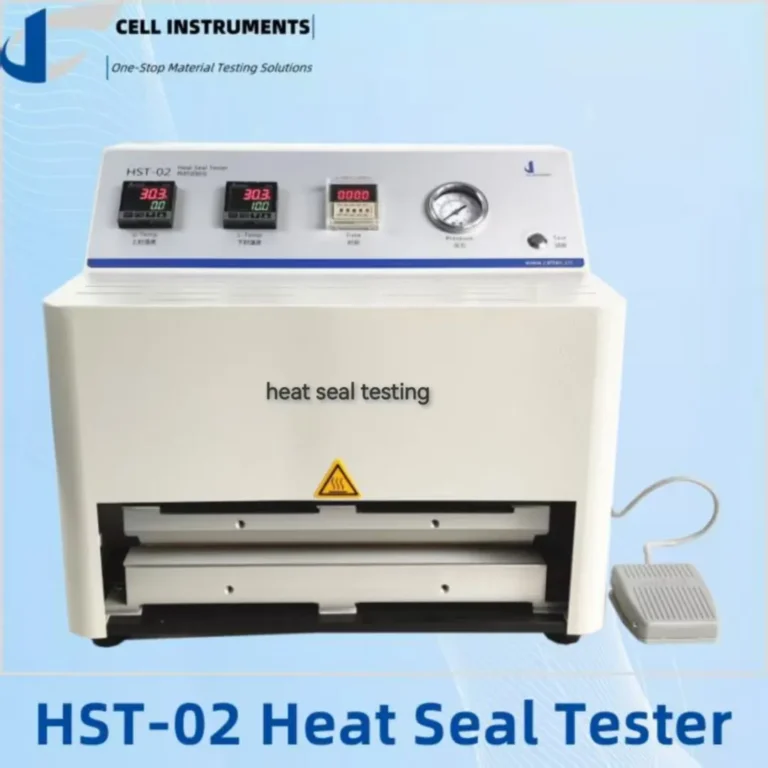
To conduct effective testning av värmeförsegling, the equipment used must be both precise and repeatable. Cell Instruments’ HST-02 Värmeförseglingsprovare is purpose-built for laboratory use and includes advanced features to meet a wide range of sealing applications.
Key benefits include:
Aluminum sealing jaws for uniform heat distribution.
Dual P.I.D. temperature controllers with ±0.2°C accuracy.
Three-directional sealing guidance system to ensure even pressure across the sealing surface.User-friendly interface for setting time, temperature, and pressure with precision.
Programmable sealing cycles for consistent testing of different materials and structures.
By using the HST-02, packaging engineers can simulate production sealing conditions in a lab environment—allowing fine-tuning of material choices, machine settings, and seal profiles before full-scale manufacturing.

Applications and Industry Use Cases
Testning av värmeförsegling is widely applied across industries where seal integrity directly impacts safety and performance:
Food packaging: Stand-up pouches, snack packs, frozen food bags.
Medical devices: Sterile barrier systems, blister packs, surgical kits.
Pharmaceuticals: Sachets, stick packs, unit-dose packaging.
Personal care and cosmetics: Sachets for creams, liquids, and wipes.
Electronics and industrial products: Moisture- or dust-sensitive component packaging.
In all these sectors, the plastfilmens värmeförseglingsförmåga can determine the product’s commercial success. Testing helps prevent issues such as seal failure, contamination, shelf-life reduction, och customer complaints.
Slutsats
Testning av värmeförsegling is an essential quality control method in flexible packaging development and production. By using a laboratorievärmeförseglare to determine the plastfilmens värmeförseglingsförmåga, companies can optimize sealing parameters, ensure product integrity, and comply with industry standards. With the precision and reliability of Cell Instruments’ HST-02 Värmeförseglingsprovare, packaging professionals gain the tools they need to prevent failure, improve productivity, and deliver high-performance packages to the market.